Starting to Homeschool

You’ve decided to start homeschooling.  Now what?  Here are some steps I would recommend taking as you move forward.

Find Out the Legal Requirements in Your State

In Florida, the requirements are not burdensome.  You will need to send a letter of intent to the county office, maintain a portfolio of student work, and comply with the accountability piece by having your child take the state assessment or a similar assessment, like the SAT-10, or have your child’s work reviewed by a certified teacher in Florida.  With the evaluation, a Florida certified teacher will come in and look at a sampling of your child’s work from the beginning, middle and end of the year to see that they are progressing.  This should not be a stressful, but one of celebration, where the children and parents can see how much they have learned over the course of the year.  I provide evaluations for different families, and it is something I look forward to each year.

Decide What Your Goals Are

Think about where you want to go, both long term and short term.  What do you want your children to have achieved by the end of the year?  Where do you want to see growth?  Do you plan to send your children back to school in a year or two?  Then you may want to take into consideration what topics are being covered in various subjects and what curriculum the school may be using, especially in the middle and high school grades.  Are you in it for the long haul?  I think you have a bit more freedom to do what you would like.   Are there areas you want to focus on?  Character training? Do you want your child to learn a trade, skill, etc.?  You may not have the answers to all of these, and that’s ok.

Determine the needs of both the Teacher and the Children

Are you looking for curriculum that is scripted or curriculum that will serve as a guide? Are you willing to piece things together yourself? Do you prefer something that allows the children to work more independently or something that calls for more teacher involvement?  Personally, I believe that kids will need the parent to be pretty hands on and involved in most subjects until at least until the third grade.  What is your budget?

As far as the children go, what is each child’s learning style?  What are their strengths and weaknesses academically? Which children may need more parent help?

Choose Curriculum

This can be a seemingly overwhelming task, with all the options and choices available.  Here are some things to take into consideration.

  • Getting some curriculum in your hands: If you have other friends who homeschool, you could ask to look at their curriculum. It’s nice to have something in your hand that you can view.  If not, most curriculum developers have samples on their websites you could peruse.
  • Family goals, convictions, and dynamics: As you are selecting curriculum, think about your family’s goals, convictions, and dynamics. Are you looking for something with a gentle approach to learning or something more rigorous? Are you looking for something Christian or secular?   How many children do you have?  What kind of schedule do your have?  Will your children return to school?
  • Instructor teaching/learning style: Think about your own teaching/learning style, and finding something you can get excited about. If you are excited about what you are teaching, the children will more than likely feed on that excitement.
  • Cost: Consider the cost of curriculum in regards to your budget

These are just a few steps you can take as you move forward.

Insect Investigation

We use BJU science 4 book as a spine for our studies, and we have been learning more about insects and spiders .  This was one of the first chapters in the book, but I saved it for the spring since I knew there would be lots of bugs to investigate and explore (homeschooling perk). The kids have enjoyed investigating the creeping critters in our own yard and community as well as learning about other bugs as well.  Though I do not want to see spiders and insects in my house, I am fascinated by the intricate care and detail God put into designing each of them.

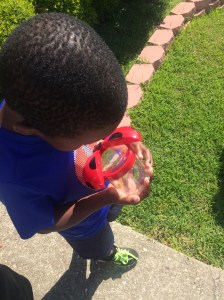
I love these learning resources bug jars .  We could catch the insects, make some observations, and then release them back into their habitat.  My son and I even got to see a bee cleaning its head with its legs in the jar!

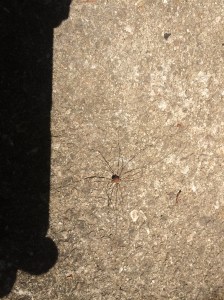
The kids had a grand time observing this harvester (daddy long legs, which is not a spider) for about an hour at the park last week.  They watched it eat, let it crawl on them, and followed it around.


After observing the insects, the older children drew and labeled the insect of their choice in their science journals.

Here are some of the books the children read as a supplement to our studies:

  • Honey in a Hive By Anne Rockwell
  • Chirping Crickets By Melvin Beger
  • What If There Were No Bees by Suzanne Slade
  • Spinning Spiders By Melvin Berger
  • Bugs, Bugs, Bugs By Jennifer Dussling
  • Bug Hide and Seek By Laura Buller
  • What Is Pollination By Bobbie Kalman

The kids enjoyed it!

Why We Homeschool

Hi, I am Teressa, and I am the wife of a fantastic husband and stay at home mom to our five wonderful children, ages 2-10.  We have been homeschooling our children from the beginning and really enjoy it.  My goal on this blog is to share some of the things we are doing and to bring encouragement to others who are homeschooling or want to homeschool.  I truly believe that most people who have a desire to educate their children at home can do it.  Let me tell you a few of the reasons we have chosen to home school.

My husband and I decided before we had any children that we wanted to educate them at home.  Our primary reason for this choice is we want to instill the truth of God’s Word and the values we hold dear to into our children’s education (Deut. 6:5-9).  We feel that God has given every parent the primary responsibility in the education of their children, regardless of the method of education (public school, private school, homeschool, etc.).  Education is not limited only to academics, but includes spiritual, relational, and emotional development as well.   It is our desire to educate the whole child. For us, we have chosen to meet that responsibility through homeschooling.

In addition, homeschooling affords us the opportunity to tailor our children’s education to meet their needs.  We want to take into consideration how each of our children learns best and allow them to move at their own pace.  This would be a difficult task to accomplish in a traditional classroom.  I am so glad that we can slow down and speed up as we need to.

Another motivation for homeschooling is our desire to spend time with our children and for our children to spend time with one another.  I am grateful for the time I have with my children.  The hours they would have been in school, we get to be together.  We are not only spending time together at homes, but we also have the opportunity to go to the park or library , hang out with friends, and go on field trips at times throughout the days of the week.  Sometimes, my husband is able to join us for a park lunch date or field trips we take.  We want to grow together as a family and a team.

I could give many more reasons why home education is right for our family, but I will stop here.  There will be time for that in future posts =).  Thank you for joining me!